Soco Loco
UX Research for an e-commerce website
CLIENT: SparkNerds
ROLE: UX Research
TIMEFRAME: 1 Month

UX Research was completed for a new multi-vendor marketplace for local creatives and entrepreneurs called Soco Loco.
My Role
SparkNerds needed help with market and user research as well as building some lo-fidelity wireframes to test out their idea. They were handling the visual design and branding, and I was brought on to conduct the research.
Objective
The objectives of this project were to devise a research plan, test out assumptions, conduct user research, and design lo-fidelity wireframes of their marketplace website.
Results
Pain points for creatives were identified and addressed in wireframes presented to the leaders at SparkNerds.
PROCESS
Challenges
The current state of e-commerce for freelancers and small business owners has primarily focused on women-led segments or specific niche groups. What existing products fail to address is growing commission costs, lengthy inventory, and shop administration time for vendors. The owners of SparkNerds had many ideas on how their product would be different from other multi-vendor marketplaces and how it would help creatives make more money. The first question was figuring out if Soco Loco was to be a viable product.
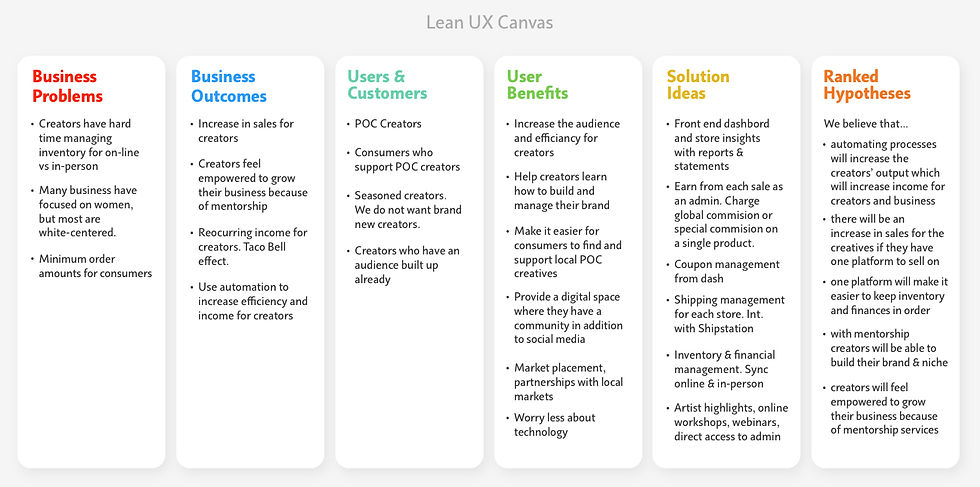
Discovery with Lean UX Canvas
I started out by running a Lean UX exercise with the owners of SparkNerds, Yocelyn, and Nsikak. They both had backgrounds as vendors in the past so they felt like they knew the pain points that already existed. The objective of the Lean UX meeting is to identify assumptions and craft some testable hypotheses for the business and users.
Assumptions from the Lean UX Canvas were outlined and turned into hypotheses. We then ranked these hypotheses in order of most important to least important.
-
We believe that automating processes will increase the creators’ output which will increase income for creators and increase income for SparkNerds.
-
We believe there will be an increase in sales for the creatives if they have one platform to sell on
-
We believe that with one platform it will be easier to keep your inventory and finances in order since you are tracking so many things on different platforms
-
We believe that with mentorship creators be able to build their brand voice or niche to build their audience
-
We believe creators will feel empowered to grow their business because of the mentorship services we will provide
-
We provide a place for our seasoned creators to sell their products so their built-in audience will buy
Research objectives & HMWs
After we identified these hypotheses, I used them to inform the research plan. I created HMW’s from the assumptions and then used those to create research objectives. These are high-level items that I was trying to learn. These are written from a user-centered perspective.

Methodology & Insights
To learn about our users 1:1 interviews were conducted with four participants. The target audience was creators with an established audience who already sell e-commerce, those who only vend in person, and customers who shop e-commerce from creators they follow. Insights were then drawn from the interviews.

User Personas, User Stories, and User Scenarios
User personas were built off of the interviews completed. Four persona types were created. Sometimes with personas, it is difficult to see how they can directly translate to designs.
Using user stories and user scenarios, it becomes clearer what user flows to prioritize in the building of wireframes. Below are images of the user personas built, how those informed user stories, and how those stories then translated to scenarios.
Two user scenarios were selected as the top priority for moving on to user journeys and flows.

Primary Users Selected


User Journeys
User journeys were created to imagine how our two key personas might actually use this product.
Main insights were drawn from the user journeys that informed user flows and final design features decisions including:
-
Browsing artist collectives on the platform
-
An easy and clear application process
-
Product pages with lots of review photos
-
Easy communication with shop owner for questions & more information


User Flows
I like to use Ryan Singer’s shorthand for writing user flows because it breaks down wordy user stories and scenarios into their most basic components. In the flows below, where you see dotted lines under the solid line represent alternate actions.


OUTCOME
Priority wireframes
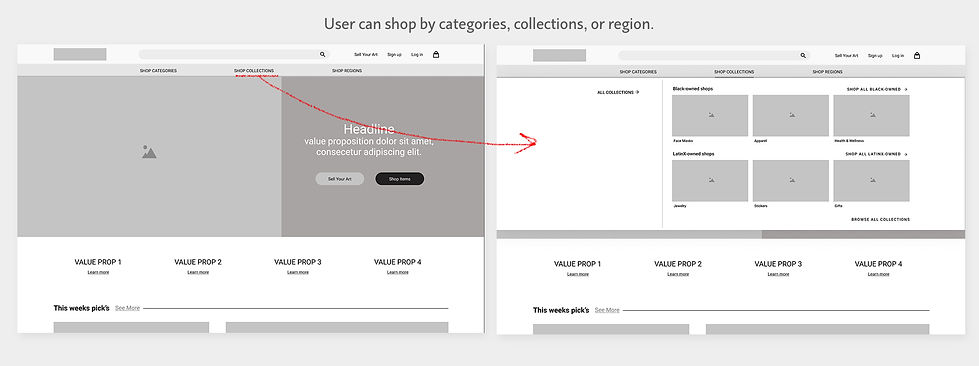
Priority screen wireframes were created to focus on the most essential user flows. These were: the landing page, all categories page, the seller application page, a shop page, and a product page.

Explore the wireframes
Lessons Learned
I learned how to lead a UX research initiative while collaborating with key stakeholders. I also learned how to use user stories and scenarios to build better user journeys and flows.